Where New Homes Are Headed in the Billings Heights
November 19, 2026
November 19, 2026
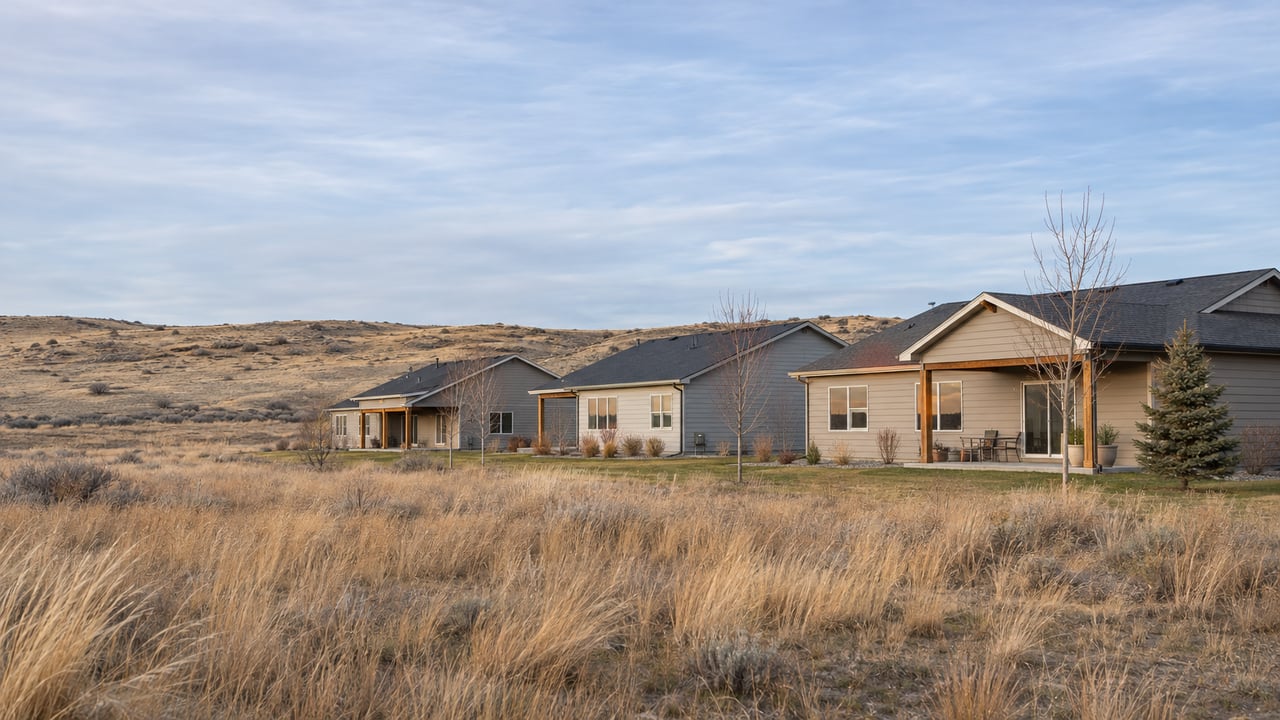
At the west end of the Heights, where Wicks Lane meets Governors Boulevard, there is a large piece of empty land. Most of it belongs to the State of Montana. It has been zoned and planned for development for years. The city's new neighborhood plan says challenging soils and economic considerations have kept anyone from building there. What changed is the road beside it. Skyway Drive opened in June 2024 and runs straight from the Heights to the West End, so the land now has much better access to the rest of Billings. The plan calls the site the West Heights Town Center. It says this may be the most likely place in the Heights for mixed-use development outside the Main Street corridor.
That site is a good way into the document. The Billings Heights Neighborhood Plan Update covers 2026 through 2045. City Council adopted it on July 27, 2026, by Resolution 26-11360, and it replaced the 2006 plan right away. If you're comparing the Heights with other parts of Billings, the plan tells you more than a median price does. It names the intersections where the city expects the neighborhood to change. The building permits issued this year show how far construction still is from that plan.
The plan's growth projection starts with population. The Heights had 29,567 residents in 2020 and is projected to reach 39,840 by 2045. It already holds about a quarter of the City of Billings' population, and it grew 50% between 2000 and 2020.
To house those people, the plan estimates the Heights needs 6,482 more units than it had in 2020. That works out to about 259 a year through 2045. From 2000 to 2020, the neighborhood added about 205 units a year, going from 7,646 to an estimated 11,751. So the plan asks for a building pace roughly a quarter faster than the Heights' long-run average, and it has to hold for the full 25 years from 2020 to 2045.
The neighborhood starts out tight. Using 2023 Census estimates, the plan puts the Heights' vacancy rate at 4.9%. That is just under the 5% line the plan treats as healthy. The City of Billings as a whole was at 6.0% and Yellowstone County at 5.6%. The plan reads the gap as stronger demand than housing production has kept up with. It notes that a shortage usually pushes prices up, and also that a shortage gives developers a reason to build.
The kind of housing in the Heights matters as much as the amount. According to the plan's 2023 figures, 24.1% of Heights homes have four bedrooms and 13.5% have five or more. Citywide, those shares are 19.9% and 10.6%. Only 2.2% of Heights units are in buildings with ten or more units, compared with 10.3% citywide. The Heights also has twice the city's share of mobile homes, 11.8% against 5.9%. The housing is also newer: 87.8% of units were built in 1970 or later, compared with 65% citywide. Household sizes are getting smaller, so the plan calls for more "missing middle" housing: plexes, townhomes and small apartment buildings. It says a wider mix of unit types could slow future price increases to some degree.
The plan focuses that growth at named intersections. The city considered three scenarios and chose one called "Neighborhood Nodes." It puts denser, mixed-use growth at specific intersections, with an Urban Residential designation across most of the neighborhood in between. Primary nodes are meant for larger concentrations of shops, homes and jobs. Secondary nodes are smaller, and the plan says one could be as simple as a corner store or coffee shop.
| Node | Type | What the plan describes |
|---|---|---|
| Main and Hilltop | Primary | South end of the Main Street strip, already has restaurants, a grocery store and transit; near the Kiwanis Trail and Two Moon Park; infill on vacant and underused parcels |
| Main and Wicks | Primary | Center of the Heights, near several schools; Wicks Lane is the main east-west transit corridor, with walking and biking improvements planned |
| Main and Billings Bypass | Primary | North end where Main splits into Highway 87 and Highway 312; mostly employment uses; vacant land toward Bitterroot Drive could become apartments and offices |
| West Heights Town Center | Primary | Wicks Lane and Governors Boulevard, mostly State land, close to schools and Castle Rock Park |
| West Heights Gateway | Secondary | Skyway Drive and Alkali Creek Road |
| High Sierra Neighborhood Center | Secondary | Annandale Road and Gleneagles Boulevard, both planned to extend |
| Alkali Creek Neighborhood Center | Secondary | Neighbors want commercial uses back in this corner |
| Bitterroot and Wicks | Secondary | Small commercial center tied to the Wicks Lane work, with denser housing nearby |
| Bitterroot and Billings Bypass | Secondary | Large undeveloped area; utility extensions may be difficult |
| East Heights Gateway | Secondary | Where the Bypass enters the Heights from its Yellowstone River crossing near Dover Park and Five Mile Road |
The plan says its Future Land Use designations suggest what zoning would be appropriate in each area. It also lists the Montana Land Use Planning Act as one of the major changes the neighborhood is adapting to. For a buyer, the table is practical information. A house a few blocks from Main and Wicks sits next to the spot the city has chosen for more activity and more homes. A house on an interior street far from every node is in the part of the Heights the plan expects to change gradually, one infill lot at a time.
Here the plan and current construction diverge. The City of Billings' September 2026 permit report shows 235 new single-family permits from January through September. The same period in 2025 had 163. Townhome permits fell from 22 to 9, and duplex permits fell from 92 to 50. Detached houses made up about 80% of new residential permits through September 2026, up from about 59% a year earlier. In September alone, the city issued 14 single-family permits, 6 duplex permits and no townhome permits.
Those are citywide numbers, and they count permits issued, not homes finished. They still show which way the market is leaning. Builders across Billings are adding the kind of home the Heights already has the most of. The smaller homes the plan says the neighborhood needs make up a shrinking share of what's going up.
Much of the new detached building is at the edge of the neighborhood. High Sierra, on the northern edge of the Heights, is still adding filings. High Sierra II, Inc. applied on July 1, 2025, for a 23rd Filing of 38 residential lots on vacant land north of Annandale Road and west of West Bonito Loop. The Board of Planning recommended conditional approval on August 26, 2025, and City Council conditionally approved the preliminary plat on September 22, 2025. The filing's subdivision improvements agreement was in the packet for the City Council meeting on October 26, 2026. The High Sierra Neighborhood Center node at Annandale and Gleneagles is meant to bring commercial uses within reach of exactly these new streets.
Each node depends on a road, and the roads are opening in a set order. Skyway Drive is open now. In September 2024, a count on the multi-use path along Skyway Drive, just north of Zimmerman Trail, found an average of 53 people walking or biking per day, with a range of 10 to 160. The plan says the effect of Skyway and the Bypass on traffic along Main Street and Wicks Lane still needs to be monitored, because the 2024 traffic counts were taken before Skyway opened.
The Billings Bypass will take longer. The Montana Department of Transportation reports that three of its six segments are open: Five Mile Road, the Yellowstone River Bridge and the Railroad Overpass. For now, the river crossing ties into Old Highway 312 by way of a temporary route on Coulson Road and the rebuilt Five Mile Road. The Five Mile Road to US 87 segment will link the bridge to Main Street on a new road north of Mary Street. It is in design, with construction tentatively scheduled for 2030. On the Lockwood side, MDT expects construction of the Johnson Lane interchange to start in late 2026 and finish by 2029.
At the south end, MDT is designing changes to the Main Street and Airport Road intersection, which carries about 63,500 vehicles a day. The chosen design adds three eastbound left-turn lanes from Airport Road onto northbound Main and a new signal at Aronson Road. Right-of-way and utility work is tentatively set for 2026 and 2027, and the construction date has not been set.
Main and Hilltop and Main and Wicks already have businesses, transit and traffic, so they need infill rather than a new road. The western nodes got their road in 2024. The East Heights Gateway already sits at the open river crossing and Five Mile Road. The Main and Billings Bypass node waits on the Five Mile Road to US 87 link, which isn't scheduled to start construction until 2030. For the Bitterroot and Bypass node and the east gateway, the plan expects utility costs to require enough density to justify the investment.
Yes, on the city side. City Council adopted it on July 27, 2026, after a July 16 public hearing before the Interim Planning Commission, and it took effect immediately.
According to the plan's engagement summary, they asked for walkability and traffic safety, parks and trails, balanced growth, more housing choices including townhomes and small apartment buildings, more local restaurants and businesses, and better stormwater, lighting and sidewalks. Residents also said they want to keep the neighborhood's family-friendly, small-town character.
The plan names Castle Rock Park and John H. Dover Memorial Park as parks whose ongoing expansion will add recreation and open space.
If you're deciding between a street near Main and Wicks and a new lot out past Annandale Road, the team at Live. Laugh. Montana. can go over the plan's map with you, address by address. Start on our Billings Heights neighborhood page. If you already own in the Heights, get your instant home valuation and schedule a consultation to see where your home sits on that map.
Stay Up To Date on The Latest Real Estate Trends

Homeownership Education
There's a number that measures how happy your house makes you. In a month built around gratitude, it might be a great number worth looking at.

Thrive at Home
The case for treating spooky season as the neighborhood holiday it secretly is, plus a bucket list to make it happen.

Live.Laugh.Empower
Real estate is one of the biggest wealth-builders most people have, and hardly anyone is taught how it works. Let's start there.

Buy
What agents can (and can't) tell you about schools and neighborhoods, and why that boundary actually protects you.

Thrive at Home
#4 is our favorite!

Thrive at Home
Because summer is a great time to start

Thrive at Home
Smart prep now = more sunshine later

Sell
Tips for Buyers, Sellers, and Homeowners
Live.Laugh.Montana. Real Estate Group is a “teamerage,” combining the strength of top-tier real estate agents with the independence of a brokerage. By bringing these areas together, we are elevating the client experience because we empower real estate agents to do what they do best without the traditional burdens and limitations of the real estate industry.
Join our community of enthusiastic subscribers and receive two emails per month packed with insights to help you live well, laugh often, and love Billings & Montana even more!
2725 Montana Ave Billings MT 59101